
Best Places to Photograph Snow-Covered Mountains in Winter
Winter transforms mountain landscapes in ways no other season can. Where to go, when to go, and what to expect — from Yosemite's granite walls under fresh snow to Zion's red canyon in a storm.
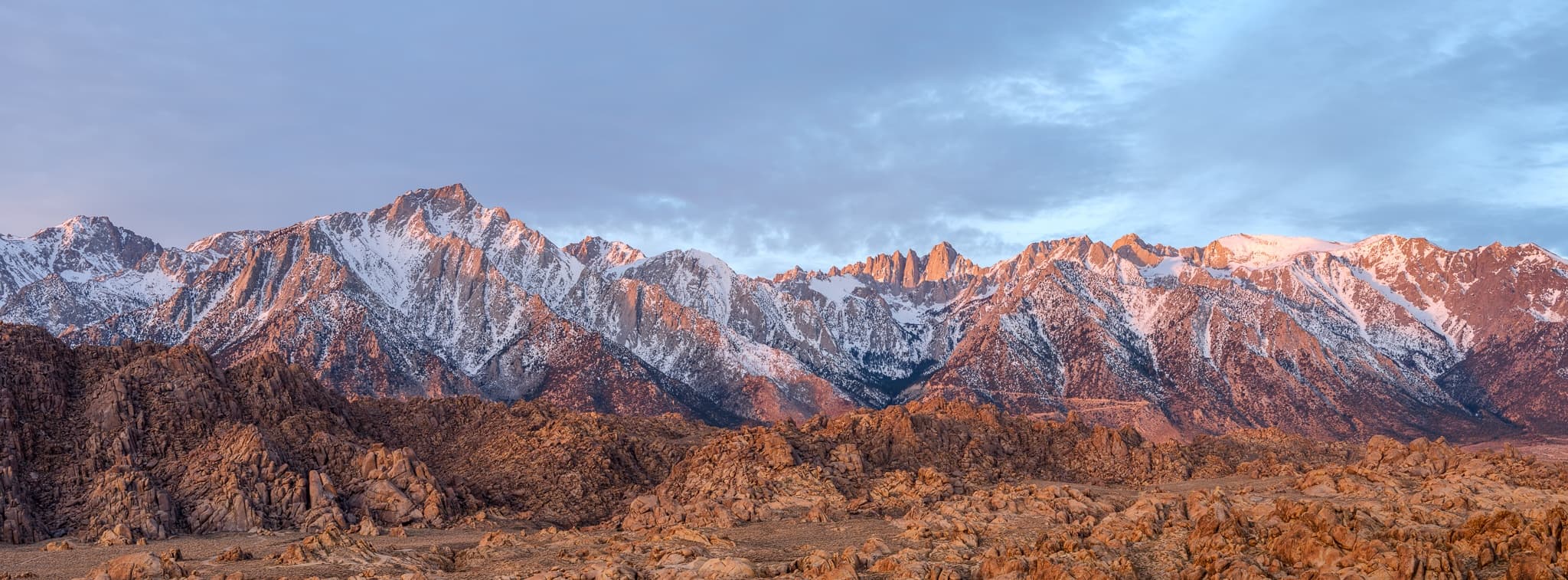
Most landscape photographers treat winter as the off-season. Cold, unpredictable weather, shorter days, roads that close without warning. That's a mistake. Snow does something to mountain landscapes that no other season can — it simplifies the scene, removes the clutter of summer green, and turns familiar locations into something you've never actually seen before.
I've been shooting mountain winters for 25 years, first on large format 4x5 film, more recently on medium format digital. These are the locations I return to. Not because they're the obvious ones — most of them are well known — but because I've learned exactly when and how to work them for winter conditions specifically.
Yosemite Valley, California
Yosemite in summer is a logistics problem. Permits, crowds, shuttle buses, three million visitors competing for the same view of Half Dome. In January it's a different place. The valley gets maybe 400 visitors on a weekday in January compared to tens of thousands in July. The shuttle runs on a reduced schedule. The Ahwahnee is still open. You can stand at Tunnel View for 45 minutes without another person walking into your frame.
What winter gives you photographically: fresh snow on El Capitan and Half Dome, ice on the Merced River, and morning reflections in the calm sections of the river after temperatures drop below freezing. The valley floor sits around 4,000 feet, which means snowfall is common but not guaranteed. The best conditions come 24 to 48 hours after a storm, when the snow is still on the walls and the sky has cleared. That clearing moment — when the clouds part and El Capitan emerges from a storm — is as good as landscape photography gets.
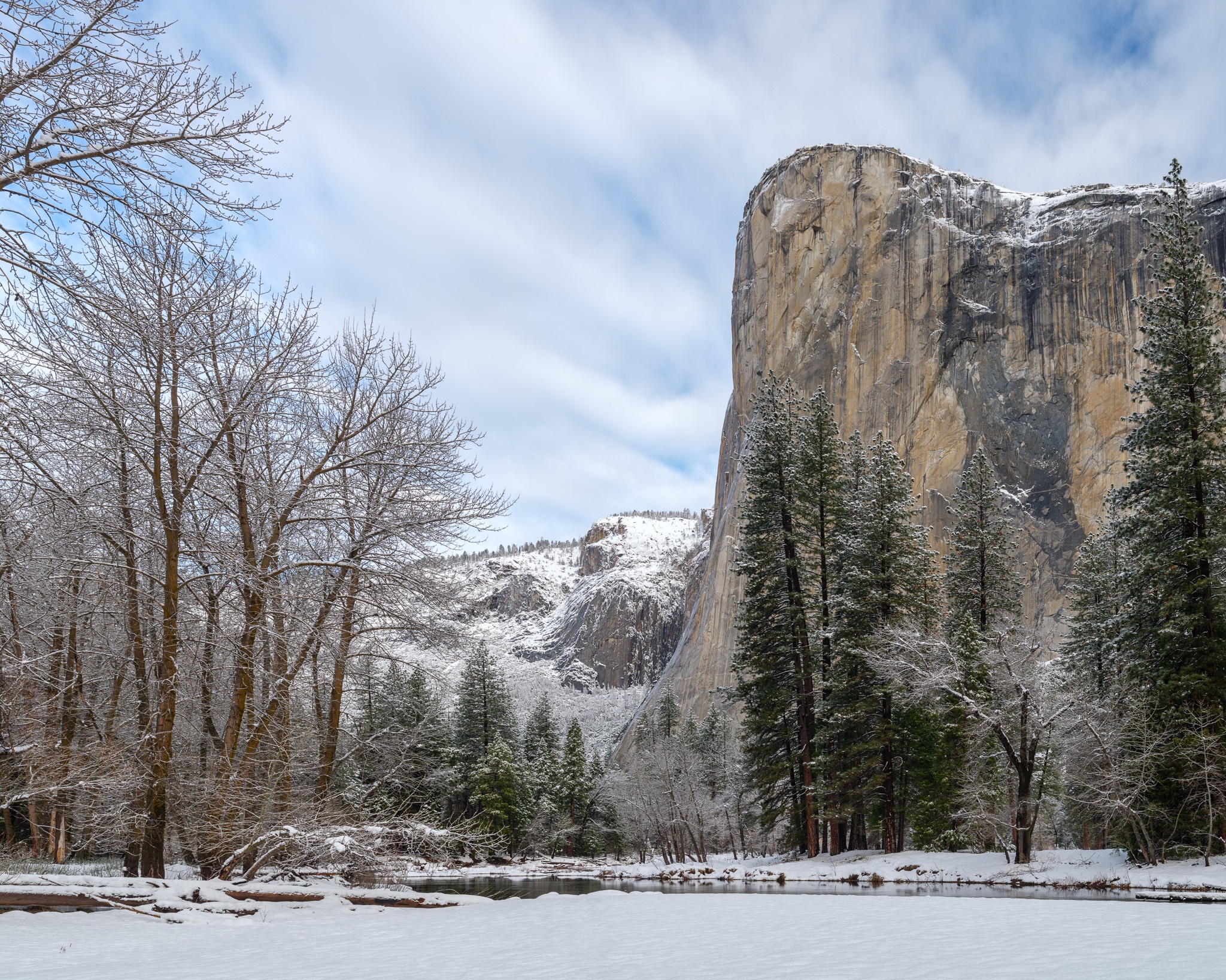
Granite Titan — El Capitan from Yosemite Valley on a winter morning, the 3,000-foot wall against clearing storm clouds. View print details →
Key Yosemite Winter Locations
Tunnel View: The classic entry point into Yosemite Valley. El Capitan on your left, Half Dome at the end of the valley, Bridalveil Fall on your right. In winter after a snowstorm, the valley floor is white, the walls are streaked with snow on the ledges, and the clearing atmosphere creates depth. Shoot it at first light before the sky goes flat blue.
Merced River reflections: The calm sections of the Merced below El Capitan hold mirror-perfect reflections on windless winter mornings. The Three Brothers — Eagle Peak, Middle Brother, Lower Brother — reflect cleanly in the water. This requires below-freezing overnight temperatures to suppress any current disturbance and clear morning skies. It doesn't happen every day, but when it does, nothing else in the valley compares.
El Capitan meadow: The longest view of El Capitan's southeast face. In winter the meadow grass is dormant and the cottonwoods are bare, which clears the foreground for a clean granite wall rising from the valley floor. Winter sunrise lights this face directly — the wall goes from shadow to gold in minutes.
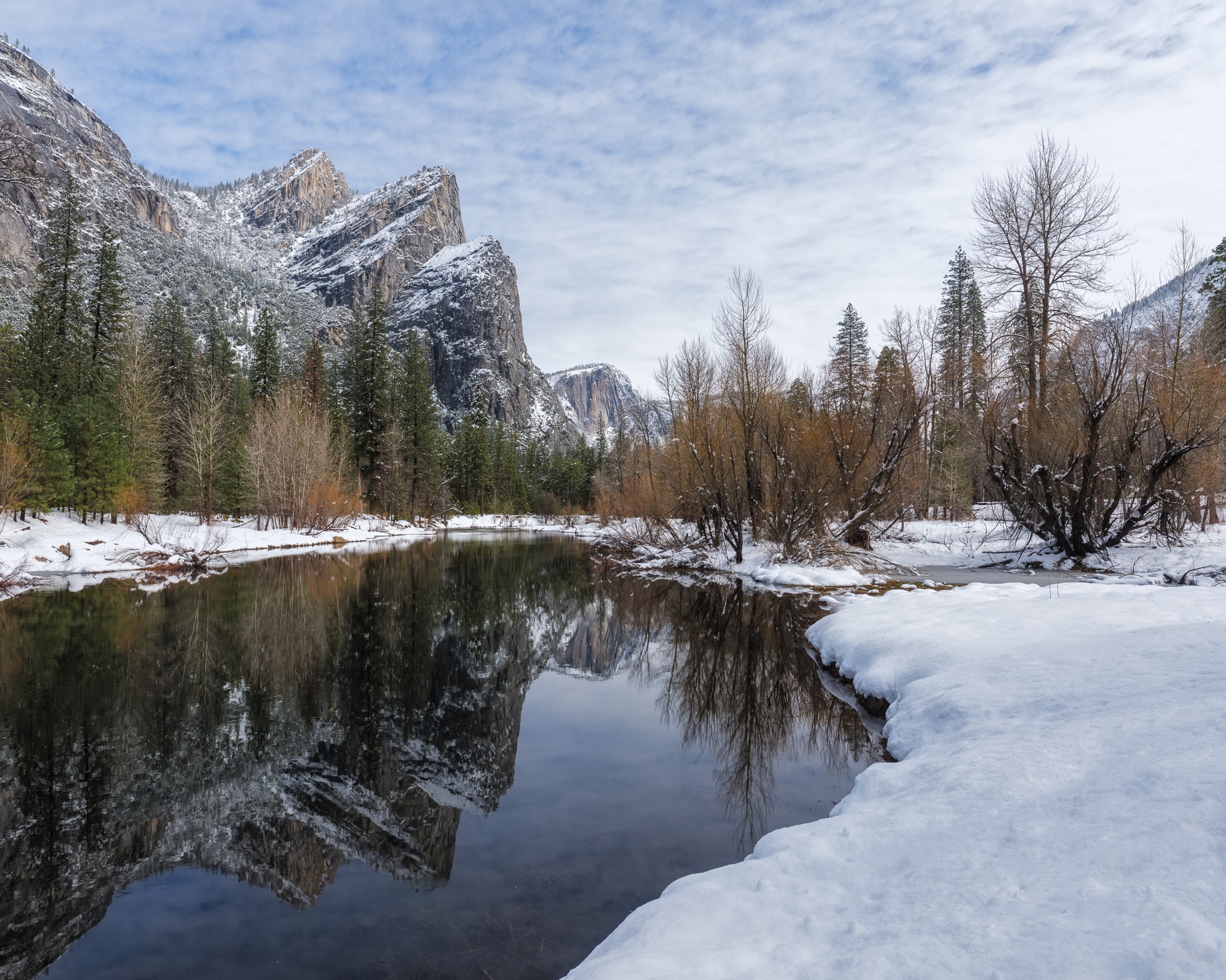
Three Brothers Reflections — the Merced River after a winter snowstorm, Yosemite Valley. View print details →
Yosemite Winter Logistics
Tioga Road closes in November and reopens in late May or early June — everything above the valley is inaccessible in winter. The valley itself stays open year-round. Chains are required on many roads after snowfall; rent a vehicle with all-wheel drive or carry chains. The Ahwahnee and Yosemite Valley Lodge operate through winter. Day-use reservations are not required in winter. Check the NPS road conditions page before driving in.
Eastern Sierra Nevada and Owens Valley, California
The eastern side of the Sierra Nevada gets less attention than Yosemite but offers something Yosemite can't: a long, unobstructed view of the entire mountain range from the floor of the Owens Valley. The Sierra Nevada rises from 4,000 feet at the valley floor to 14,000+ feet at the peaks in less than 15 miles of horizontal distance. That wall of snow-covered granite, lit at sunrise, is one of the most dramatic winter mountain views in North America.
The Owens River winds through the valley floor at the mountains' base. In winter the water moves slowly, holding reflections of the peaks and the predawn sky. The light here moves fast — the Sierra blocks direct sunlight until the sun is well above the horizon, then the peaks catch it while the valley is still in shadow, creating a split-lit scene that's gone in 20 minutes. You need to be in position before astronomical twilight and ready to shoot the moment the first peak catches direct light.
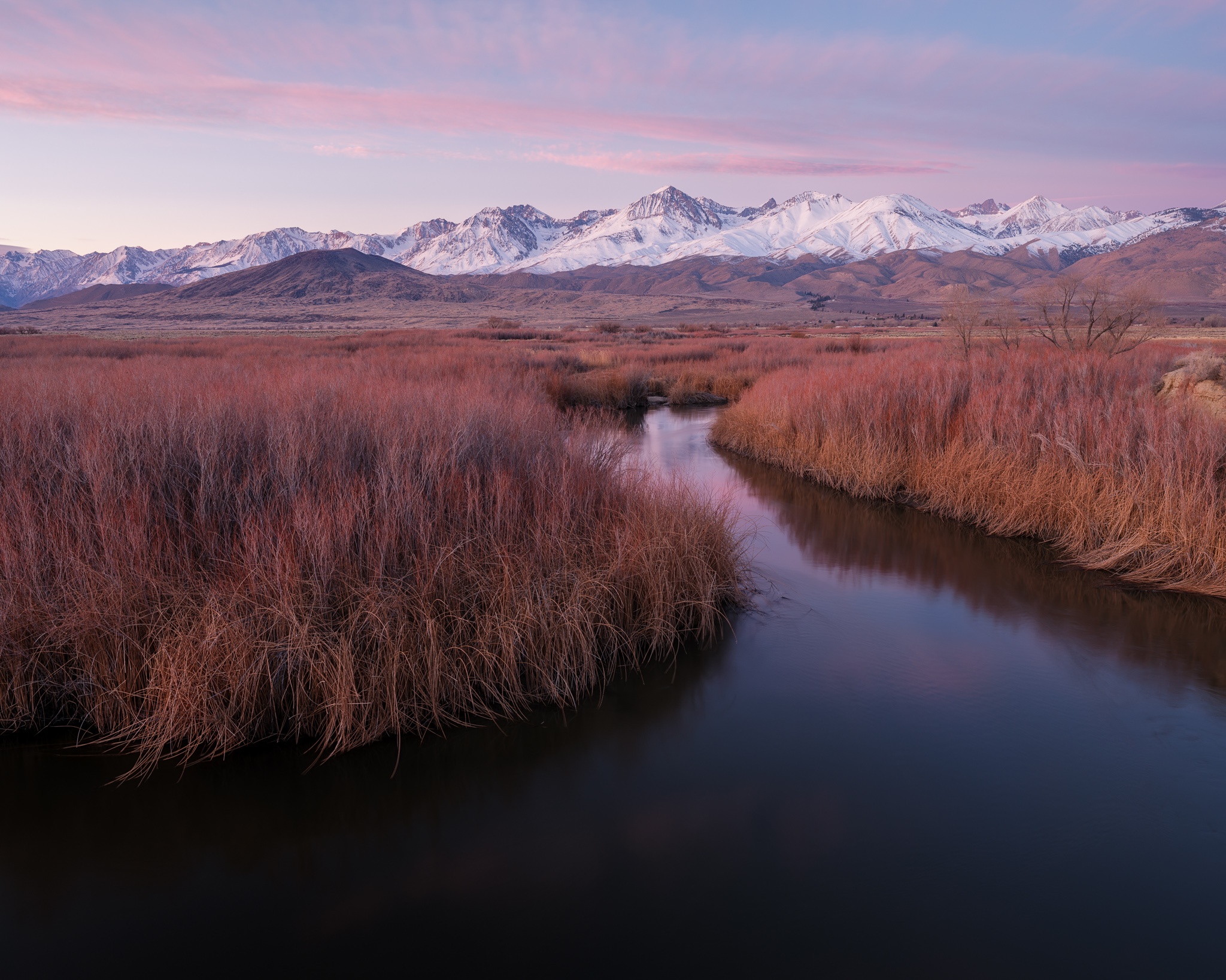
Owens River Sunrise — dawn over the Eastern Sierra, the river reflecting pink sky while the peaks catch first light. View print details →
Eastern Sierra Logistics
Bishop and Lone Pine are the main base towns for Eastern Sierra winter photography. US-395 runs the length of the Owens Valley and stays open year-round. Temperatures at the valley floor reach single digits overnight in January — dress accordingly and keep your batteries warm. The Alabama Hills above Lone Pine give the most dramatic foreground for the mountain range views; the Owens River around Bishop is better for reflection photography.
Zion National Park, Utah
Zion in winter is a different argument than Yosemite or the Sierra. The mountains here aren't snow-covered peaks — they're red and white sandstone walls, 2,000 feet high, that occasionally catch snow on the ledges and canyon floor. What winter gives you at Zion is color contrast that doesn't exist any other time of year: burnt orange walls against white snow, dark green cottonwoods against the pale blue sky of a clearing storm. The familiar canyon turns strange.
The shuttle doesn't run in winter, which means you can drive your own vehicle up Zion Canyon Scenic Drive. That's the biggest practical difference from a summer visit, and it matters for photography: you can stop wherever you want, whenever you want, without waiting for the next bus.
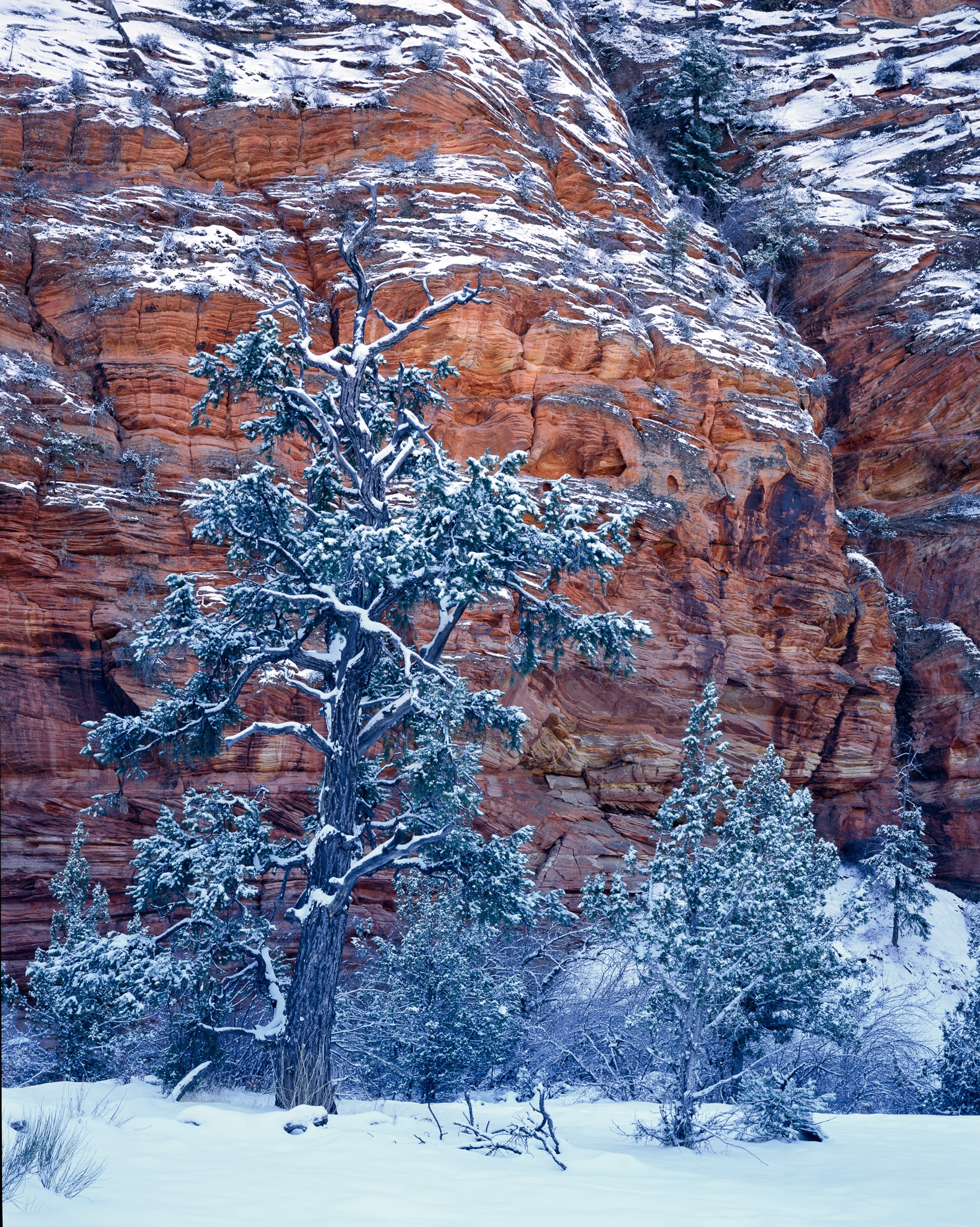
Zion Snowstorm — the canyon walls during a winter storm. Shot on Fujichrome Provia 100F on a 4x5 large format camera. View print details →
Zion Winter Logistics
Springdale is 45 minutes from St. George, Utah, and the drive stays accessible most winters. Snow is not guaranteed at Zion — the canyon sits at 4,000 feet and gets maybe 15 days of snow per year. When a storm does hit, the clearing conditions that follow are exceptional. The trade-off: you may arrive for a planned winter shoot and find no snow at all. Checking the forecast the week before and staying flexible on dates makes a real difference.
Winter Mountain Photography: What Actually Works
Go After the Storm, Not During
Shooting in active snowfall produces flat, gray images with no shadow detail and a hazy atmosphere. The exception is slow-shutter intentional blur of falling snow as a compositional element, which works in specific situations. For snow-covered peaks with clear skies and dramatic light, you want 12 to 48 hours after a storm clears. The snow is still on the mountains, the sky is deep blue, and you have actual shadows defining the terrain.
Expose for the Snow
Camera meters don't know what white is. Bright snow reads as 18% gray to your meter, which means automatic exposure consistently underexposes winter mountain scenes by 1 to 2 stops. Add +1 to +1.5 stops of exposure compensation from your meter reading, or use manual exposure and check the histogram. Snow should look white in your histogram, not gray — the right edge should be touching, not blowing out.
Golden Hour Is Different in Winter
The sun rises lower on the horizon in December and January, which means golden hour light skims the mountain tops at a shallower angle and lasts longer. At Yosemite in January, the first light on El Capitan is warmer and more raking than anything you'd see in June. The tradeoff is a shorter window of usable daylight — the sun sets by 5 PM and the valley goes cold fast. Plan to be in position 30 minutes before astronomical twilight and stay until 20 minutes after the sun drops behind the peaks.
Cold Weather Gear That Matters
Battery life drops significantly below freezing — carry a spare in an inner pocket against your body. Tripod legs that touch cold ground soak heat from your hands through the metal; use flip-up rubber or cork grip sections where available. Condensation is the real risk when moving from cold outside to warm inside: seal your camera bag before coming indoors and let it warm slowly to room temperature before opening it. A cotton cloth in the bag helps absorb moisture as the temperature equalizes.
Fine Art Prints
Winter Landscape Photography Prints
Snow-covered mountains and winter canyon landscapes from Yosemite, the Sierra Nevada, and Zion — photographed on large format film and medium format digital. Limited edition fine art prints with certificate of authenticity.
Winter mountain photography rewards preparation more than any other type of landscape work. The weather windows are narrow, the light moves fast, and the conditions that produce exceptional images — fresh snow, clearing skies, cold overnight temperatures — don't announce themselves far in advance. The photographers who come back with the best work are the ones who've already scouted the location in a different season, know exactly where they want to stand, and can be in position at 6 AM when the window opens.
For more on how I approach location planning, see my guide to scouting locations for landscape photography. To see the full range of winter work, browse the winter landscape gallery.
Frequently Asked Questions
- What is the best time of year to photograph snow-covered mountains?
- January and February offer the most reliable snow coverage at lower elevations. The optimal timing is 24 to 48 hours after a winter storm clears — the snow is still on the peaks, the sky has opened up, and you have the contrast between white peaks and blue sky that makes winter mountain photography compelling. Shooting during active snowfall produces flat, gray images without the light and shadow that define mountain terrain.
- Which national parks are best for winter mountain photography?
- Yosemite National Park offers the most dramatic winter mountain photography in the US — El Capitan and Half Dome with fresh snow, Merced River reflections, and dramatically reduced crowds. The Eastern Sierra Nevada provides long panoramic views of snow-covered peaks from the Owens Valley floor. Zion National Park is exceptional when it gets snow, though it's not guaranteed — the canyon sits at 4,000 feet and averages around 15 snow days per year.
- How do you expose correctly for snow-covered mountains?
- Add +1 to +1.5 stops of exposure compensation from what your camera meter recommends. Camera meters are calibrated to 18% gray, and bright snow reads as gray — this causes consistent underexposure of winter mountain scenes. Check your histogram after each shot and make sure the snow is at or near the right edge of the histogram without clipping. In manual mode, set exposure so the snow just touches the right side of the histogram without blowing out.
- Is Yosemite open for photography in winter?
- Yes. Yosemite Valley stays open year-round. Tioga Road (the high country route) closes by November and reopens in late May or early June, so the high elevation locations are inaccessible. The valley itself — El Capitan, Half Dome, Tunnel View, the Merced River — is fully accessible. Day-use reservations are not required in winter. Chains may be required on valley roads after snowfall; check the NPS road conditions page before driving in.
Explore Related Photography
Enjoyed this article?
Subscribe for more photography stories, techniques, and exclusive behind-the-scenes content.
Related Posts
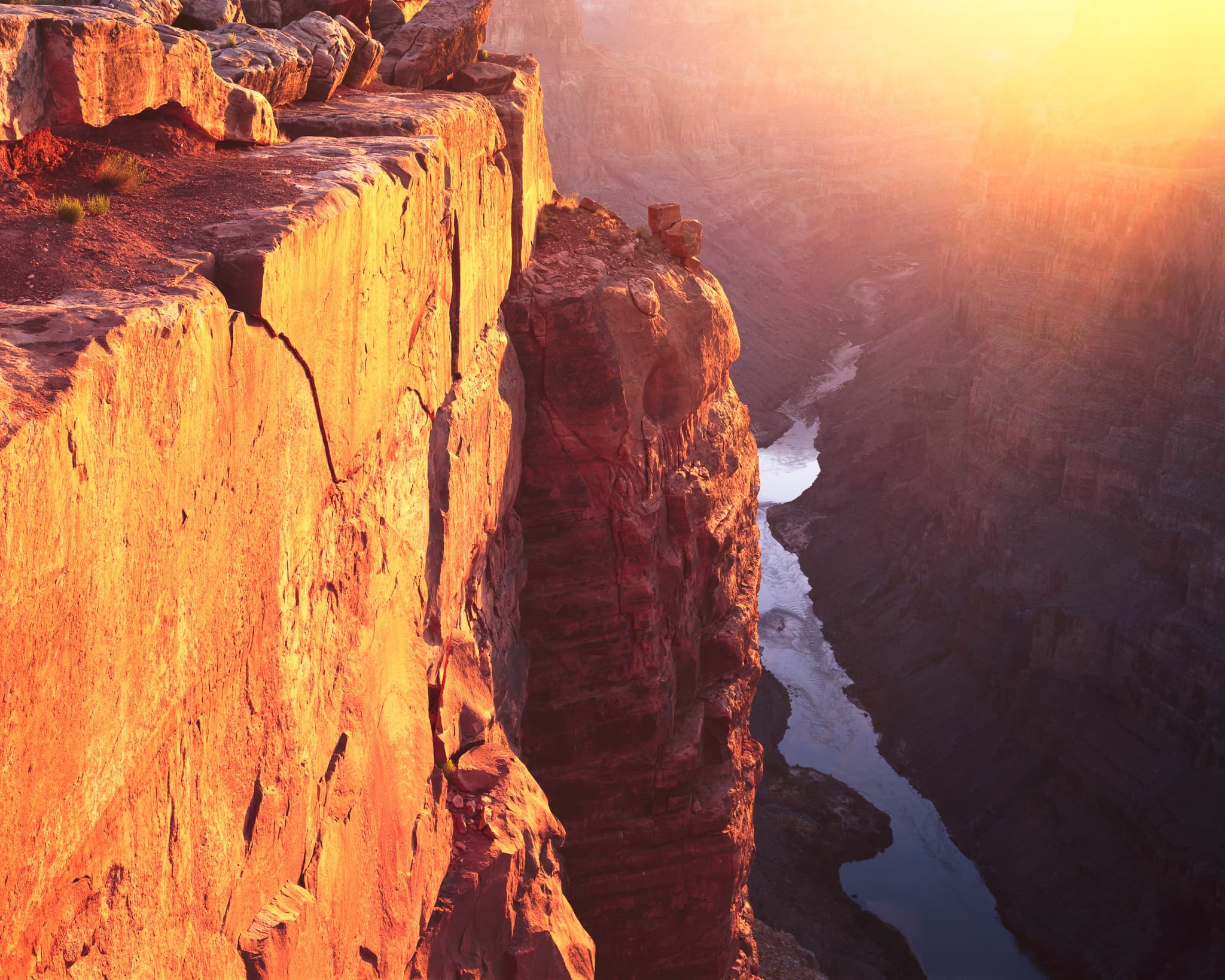
Grand Canyon Photography Guide: Best Spots, Light & Timing
The famous south rim overlooks are worth making. But the Grand Canyon images I keep coming back to came from a remote western overlook that requires 60 miles of unpaved road to reach — and from the North Rim in October, when the crowds are gone and the canyon light gets serious.
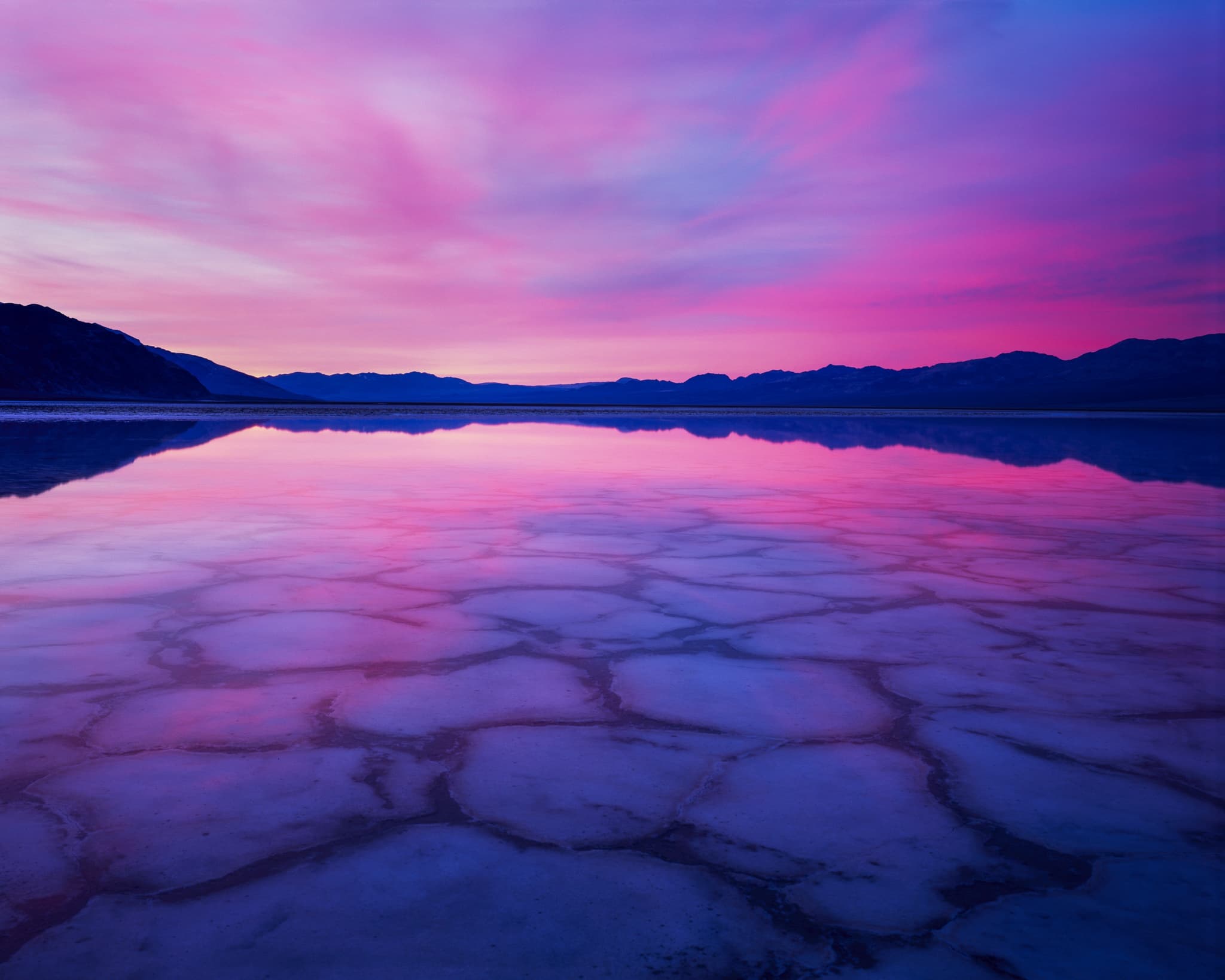
Analog Landscape Photography: Why Film Still Makes Sense in 2026
Most photographers who've tried 4x5 large format film don't go back to digital for their serious landscape work. Here's the honest case for shooting analog in an era when you have no practical reason to.
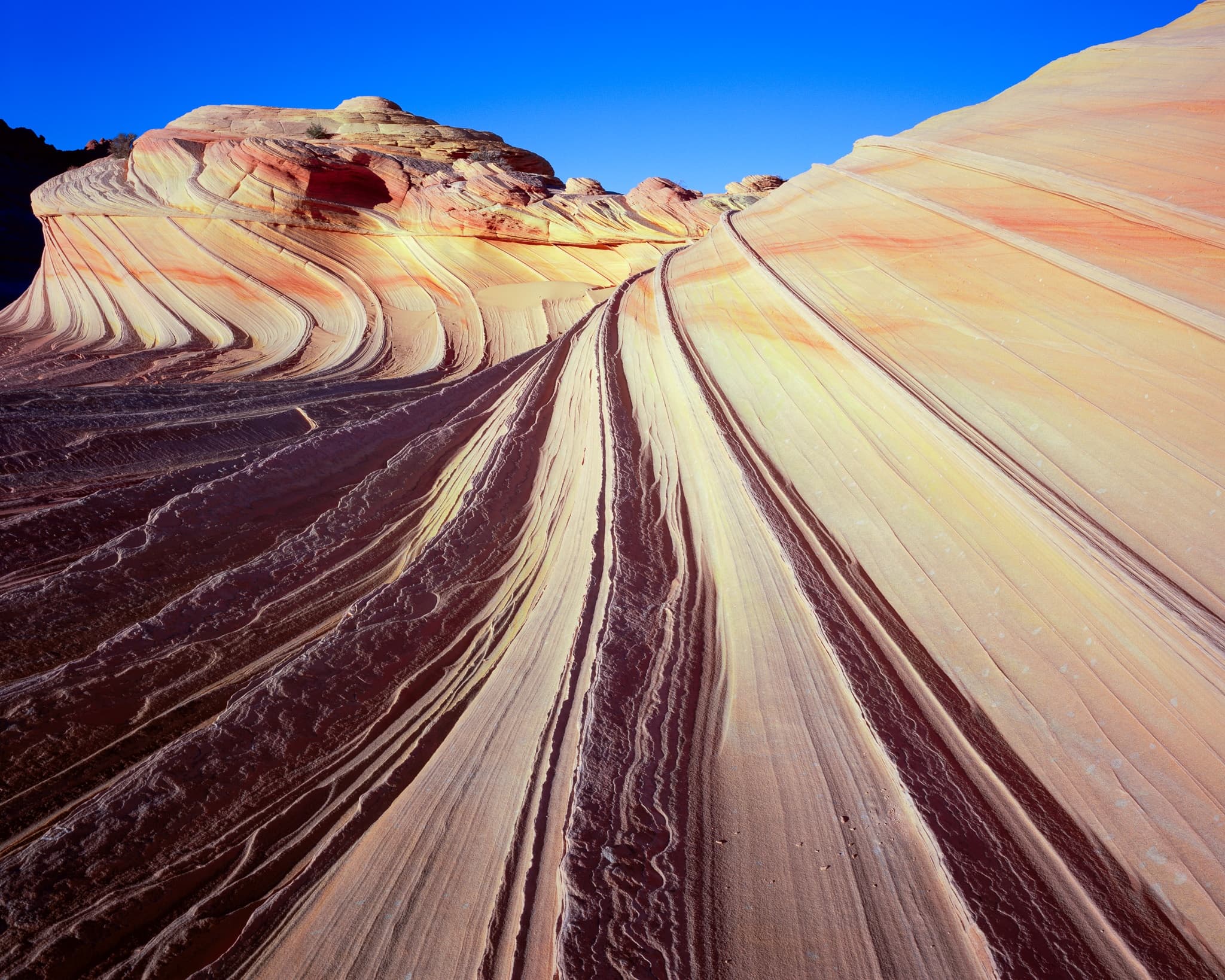
Limited Edition Landscape Prints for Sale: Southwest Fine Art Photography
A look at what makes a limited edition landscape print worth owning — how editions work, what media options hold up over decades, and which prints from the American Southwest collection are still available.
Tags
Marty Quinn
Large format film photographer based in Phoenix, Arizona. Shoots on 4x5 Arca-Swiss view cameras across the American Southwest — Utah, Arizona, Death Valley, and the Colorado mountains. 25+ years behind the lens. Published in Outdoor Photographer magazine (The Last Frame, June 2008). About Marty →