
Aspen Trees in Fall: A Photographer's Guide to Colorado
Quaking aspens put on one of the most photogenic shows in North America every October. This is where I shoot them, when to go, and how to deal with the wind, the narrow timing window, and the crowds at the good spots.
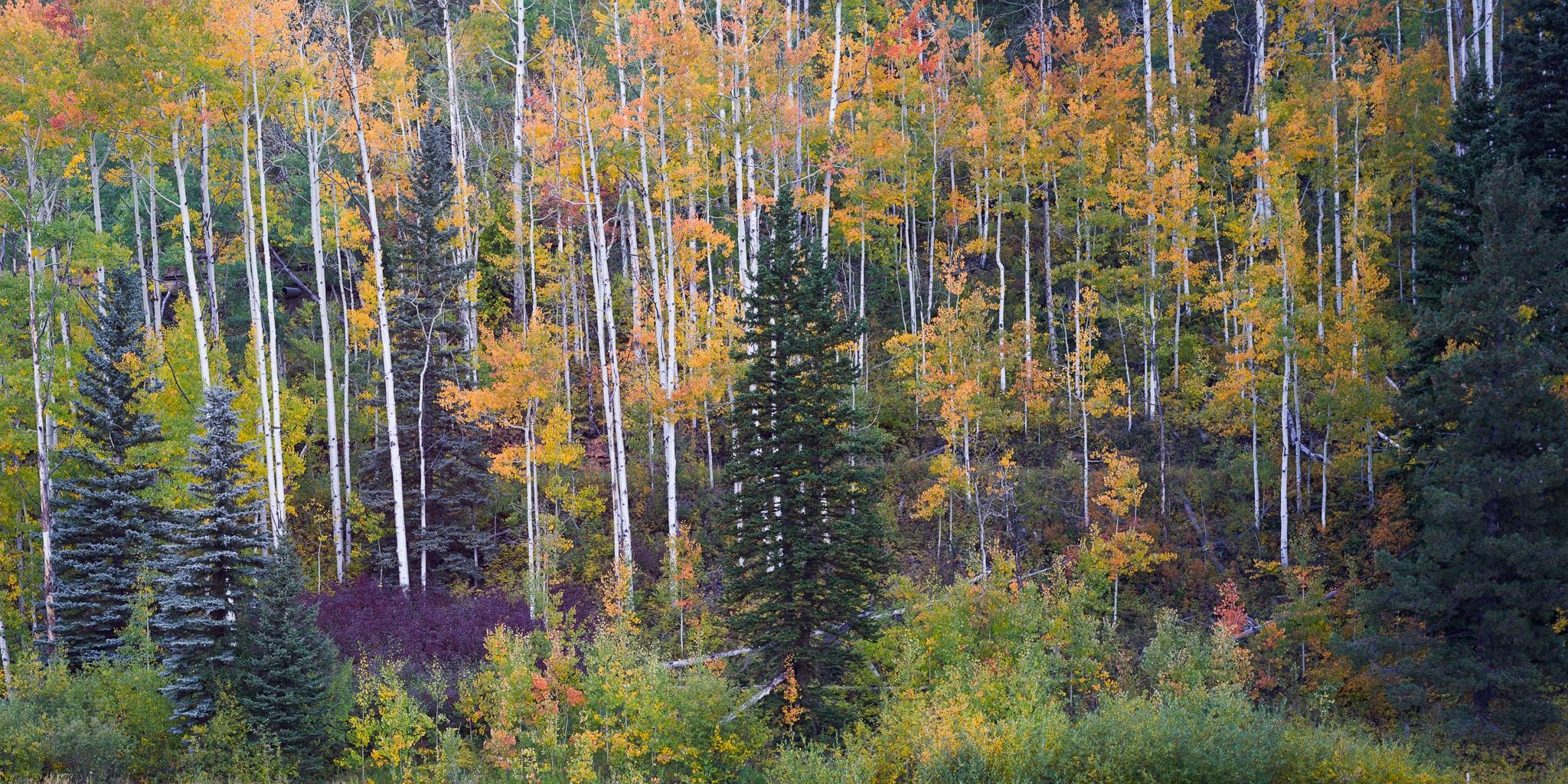
Why Aspen Trees Are Different
Most trees change color on their own schedule. Aspen trees change together. A single grove is often one organism — thousands of trunks sharing a root system, one genetic individual that can cover acres and live for thousands of years. When fall arrives, every trunk in the colony turns at the same moment, the same color, responding to the same biological signal.
For photographers, that synchrony is the whole point. You don't get scattered pockets of color mixed through green. You get walls of gold. Stands where the light filters through a canopy that's gone entirely yellow, turning everything underneath it amber. The white bark against that backdrop is almost too good. It's the reason I keep coming back to Colorado every October.
That said, synchrony doesn't mean uniformity. Even within a single grove you'll often see greens, yellows, oranges, and reds side by side — different-aged trunks, variations in soil moisture, shade from neighboring conifers. A hillside that looks solid gold from a distance can be a patchwork of color up close. That's not a disappointment. It's usually better to photograph.
I've been shooting aspen groves on 4x5 large format film for over twenty years. Fujichrome Provia 100F and Kodak E100 both render that yellow-gold in a way I've never been able to replicate digitally, a warmth with actual depth to it. The images in my fall color gallery come mostly from the San Juan Mountains of southwestern Colorado, which I consider the best aspen country in the lower 48.
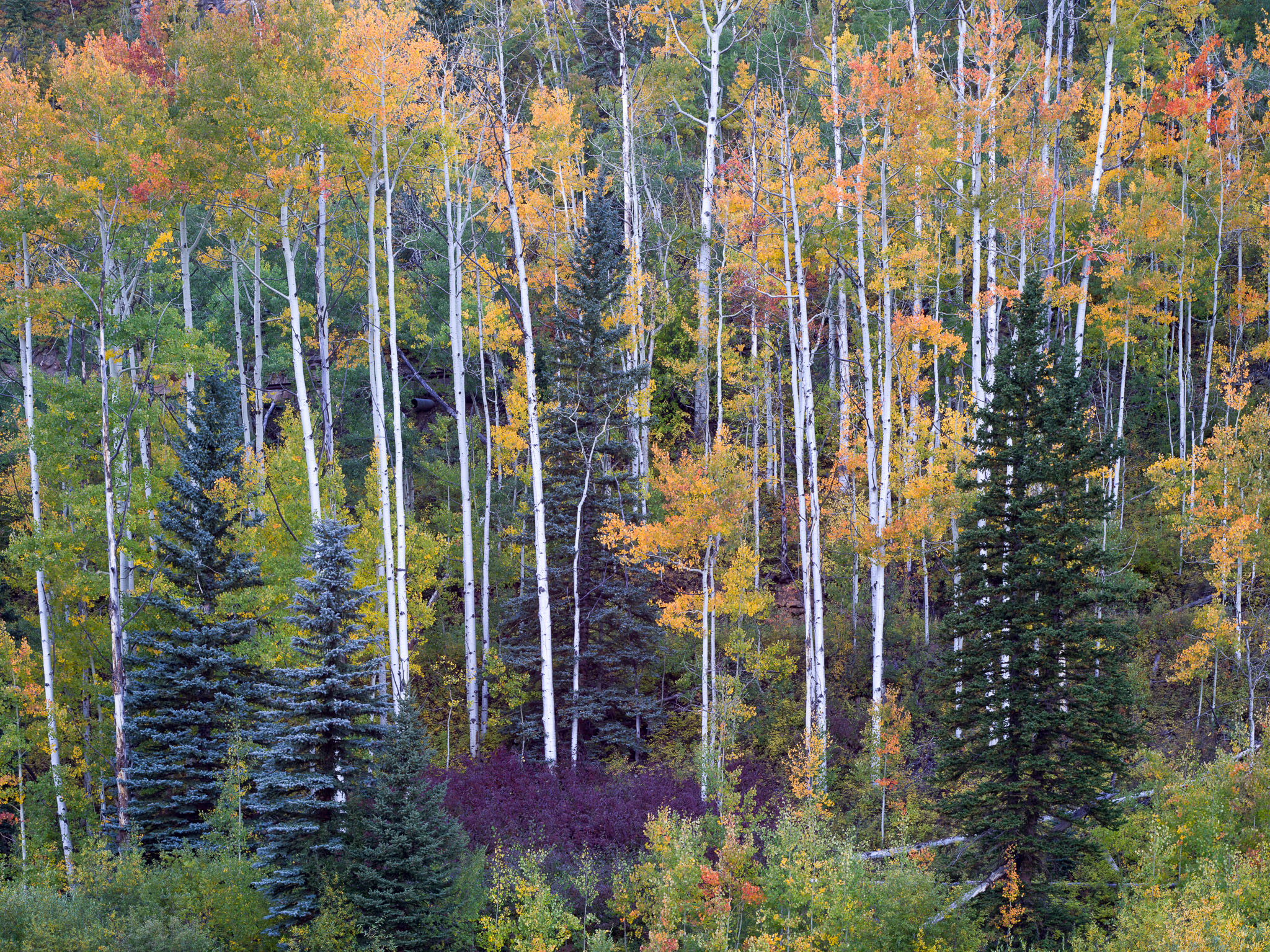
Aspen Color — Colorado Rockies, Fujichrome Velvia 50, 4x5 large format. View print details →
When Peak Color Happens
Elevation drives the timing more than anything else. In Colorado's San Juans, color typically runs like this:
- High elevations (10,000–12,000 ft): Mid-September. These groves are usually first, and they can peak and drop fast. Sometimes within a week.
- Mid elevations (8,000–10,000 ft): Late September through early October. The sweet spot for most photography. Accessible roads, better weather odds.
- Lower elevations (6,500–8,000 ft): Early to mid-October. Later color, often mixed with oak brush going rust-red alongside the aspen gold.
The window at any given location is narrow, often 10 days from first color to bare branches. A wet summer with an early frost sharpens everything up. A dry summer with a warm fall can extend the season but also mutes the colors. Check elevation-specific forecasts on the Colorado fall foliage report, and be ready to move fast when conditions line up.
One thing that trips people up: peak color and peak light don't always overlap. You can have perfect golden leaves under flat gray skies, or brilliant light on a grove that's dropped half its leaves in a storm. I've driven to Ouray in spectacular light only to find every grove stripped bare. That's just how it goes. Build in multiple days if you can.
The Best Locations for Aspen Photography in Colorado
San Juan Mountains
This is the area I know best and keep returning to. The concentration of accessible aspen stands around Ridgway, Ouray, Silverton, and the Million Dollar Highway is hard to match anywhere in the country. The mountains themselves — the Sneffels Range, the Grenadiers, Engineer Mountain. They give you something to put behind the trees.
Owl Creek Pass between Ridgway and Cimarron is a personal favorite. The road climbs through extensive groves with the Cimarron Ridge in the background. Dallas Divide, just west of Ridgway, gives you the classic Sneffels Range view with aspen-covered lower slopes. Both are accessible by passenger car in good conditions.
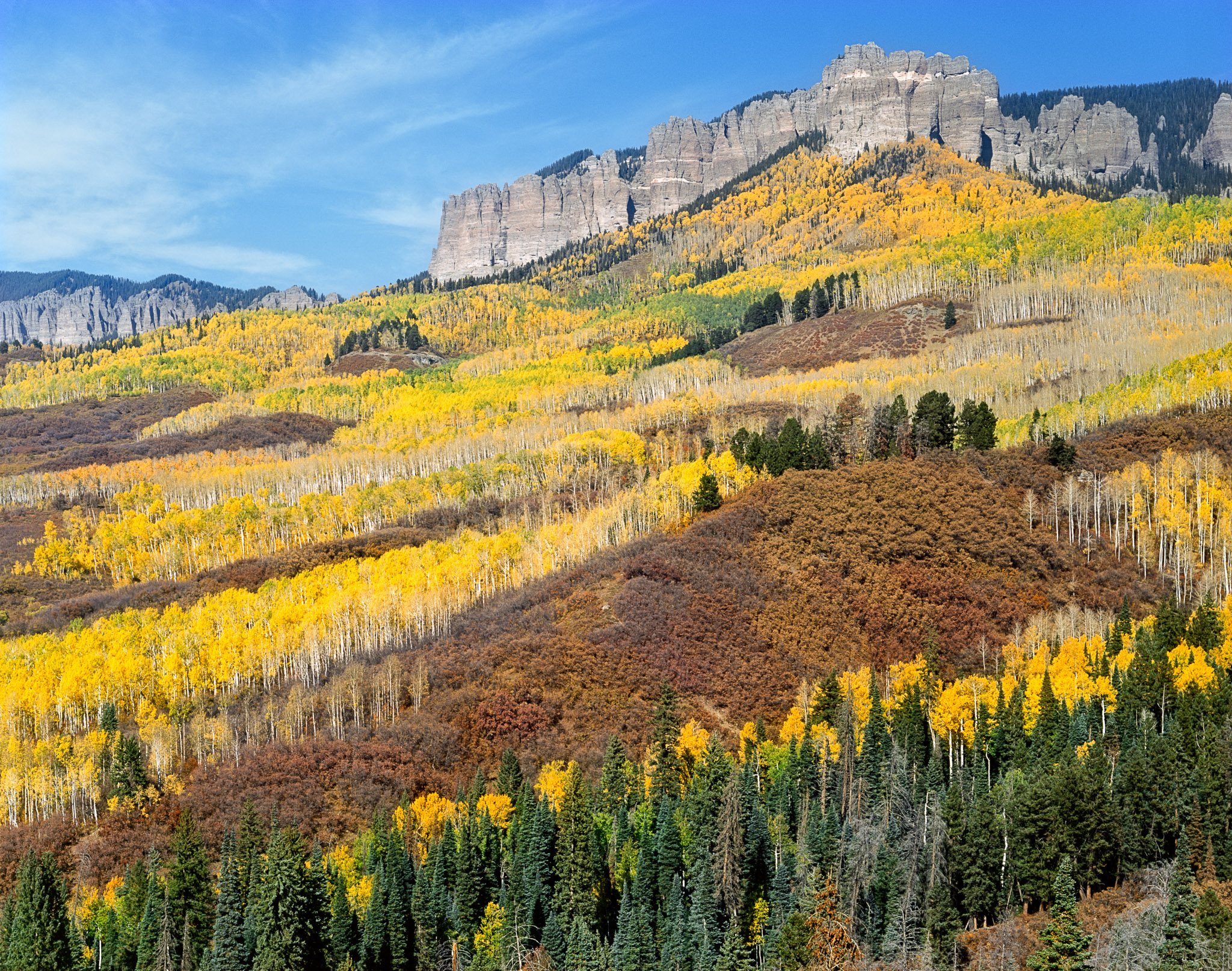
Owl Creek Overlook — Uncompahgre Country, Colorado. Kodak E100, 4x5 large format. View print details →
Kebler Pass
West of Crested Butte, Kebler Pass has some of the largest contiguous aspen groves in North America. The road is dirt but generally fine for two-wheel drive. The sheer scale here is different from the San Juans — you're inside the grove, surrounded, not looking across a valley at it. Bring a wide lens and plan to spend time.
Maroon Bells
Probably the most photographed aspen location in Colorado, and the crowds reflect it. The Maroon Bells have the advantage of a dramatic mountain backdrop with aspen-covered slopes leading to the lake. Mandatory shuttle buses operate in peak season, which limits your flexibility a bit but also keeps the road from becoming a parking lot. Worth doing once.
Aspen, Colorado (the Town)
Independence Pass and the Elk Mountains around town have great coverage. More crowded, obviously. But Independence Pass itself, especially the groves on the eastern descent, can be exceptional and is less trafficked than the Maroon Bells.
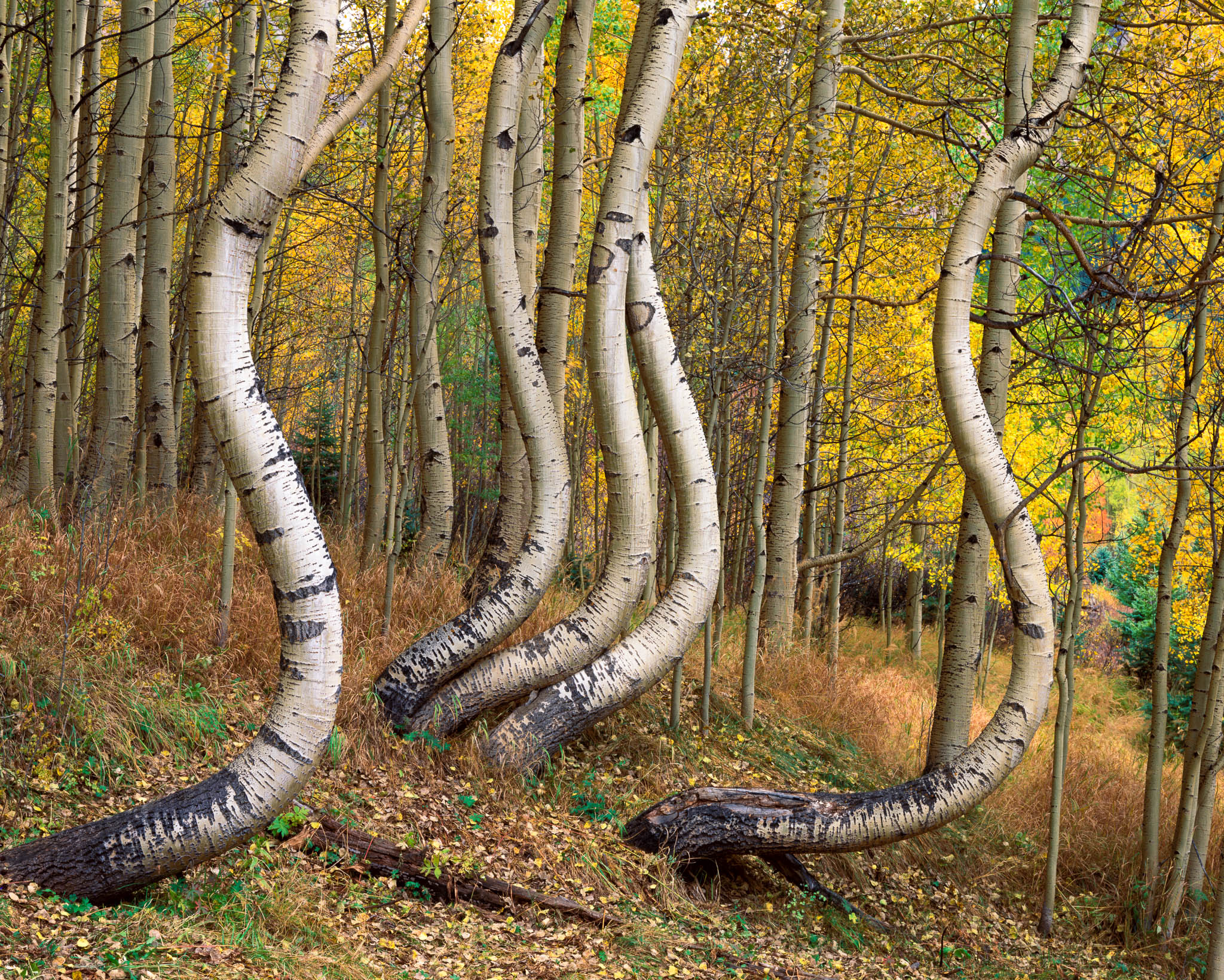
Curved Aspen — San Juan Mountains, Colorado. Fujichrome Velvia 50, 4x5 large format. View print details →
Planning Your Colorado Aspen Trip
Getting to the San Juan Mountains
The hub towns for San Juan aspen photography are Ridgway, Ouray, Silverton, and Telluride. Distances from nearby cities:
- Denver to Ridgway: 330 miles via US-50 through Gunnison (approximately 5.5 hours)
- Grand Junction to Ridgway: 135 miles (about 2 hours)
- Albuquerque to Ouray: 280 miles (approximately 4.5 hours)
- Telluride Regional Airport (TEX) offers limited regional flights from Denver if driving isn't an option
Ridgway is the central base for the San Juan corridor, 10 miles north of Ouray, 30 miles from Telluride, and close to both Owl Creek Pass and Dallas Divide. It's a small town. Book accommodation weeks out if you're targeting the last week of September during peak color.
Kebler Pass and Crested Butte
Crested Butte is the base for Kebler Pass. From Denver it's a 230-mile drive over Monarch Pass, closer than the San Juans and a different trip. If you have a week, a good route takes you through Kebler first heading south from Denver, then continues into the San Juans. The two areas feel completely different from each other — Kebler is immersive and enclosed, the San Juans open and dramatic.
Permits and Fees
Most aspen photography in Colorado requires no permits. Owl Creek Pass, Last Dollar Road, and Dallas Divide are all on public BLM or National Forest land. Maroon Bells requires a shuttle ticket during peak season, purchased in advance through the Aspen Recreation Department. No photography fees at any location covered in this guide.
How to Actually Photograph Aspen Trees
Light Quality Matters More Than Direction
The standard advice (shoot golden hour) isn't wrong, but it's incomplete. Overcast light in an aspen grove can be extraordinary. Diffuse cloud cover saturates the yellows and eliminates the harsh shadows between trunks. The leaves glow against dark conifers in the background. Some of my favorite aspen images were made under a thin overcast at 10 AM.
Direct morning or evening light works best when you're working with a mountain backdrop or a view across a valley. The raking light picks up texture in the hillside and separates the planes of color. When you're inside a grove shooting up through the canopy, diffuse light usually wins.
Backlight through the leaves is its own thing entirely. Stand so the sun is behind the canopy and the leaves light up from behind — they go translucent, almost glowing. The white trunks hold their brightness. This works especially well in the hour before noon on a clear day, when the sun is high enough to push through the canopy but the leaves are still catching direct rays.
Working with the Trunks
The white bark is the structural element of aspen photography. How you position the trunks in the frame changes everything. A few approaches that work:
- Parallel trunks as rhythm: Find a grove where the trees grow relatively straight and evenly spaced. Shoot straight on to create a repeating vertical pattern. Works well with a longer focal length that compresses the spacing.
- Single tree as subject: A curved or isolated trunk against a background of color creates a more intimate image. Look for trunks with interesting scarring, lean, or shape.
- Canopy only: Lie down, point up. Shoot the intersection of branches, sky, and leaves. Different season, different location — still works in October when the canopy is pure gold.
- Understory: In a dense grove, the floor is often clear — leaf litter, some undergrowth. A wide shot from low shows the full tree height with the canopy overhead. This is where a tilt function on a view camera earns its keep, keeping everything from ground to crown in focus.
Wind
Aspen leaves shake in almost no wind at all. That's the common name, quaking aspen, and it's accurate. Any breeze and the leaves are moving. For sharp foliage you need either very fast shutter speeds (1/500 or faster) or calm conditions. Early morning, when the air is still, is your best bet. By midday the mountain thermals have usually picked up enough to ruin a slow shutter.
With large format film and a tripod, this matters. I'm often working at f/22 and ISO 100, which puts me at slow exposures even in decent light. I'll wait for a lull, watch the nearest leaves, and trip the shutter when things settle. Sometimes I wait ten minutes for ten seconds of calm. That's just the format.
Film vs. Digital for Aspen Color
Fujichrome Provia 100F and Kodak E100 both give aspen color a richness that's genuinely different from digital. The yellows have a depth to them, not oversaturated, just richer. The white trunks hold detail without blowing out even when the leaves are fully exposed. I've tried to match both in Lightroom on digital files and gotten close, but never identical.
Digital has the obvious advantages: immediate feedback, no wind-blur risk at ISO 100, more flexible white balance. The one trap with digital aspen images is how easy it is to overdo the editing. Saturation in particular — aspen gold is already vivid, and pushing it further makes the image look like a painting. A small adjustment usually does the job. Pull saturation and vibrance back slightly and let the actual color carry the frame. Oversharpening foliage is the other fast track to making it look fake.
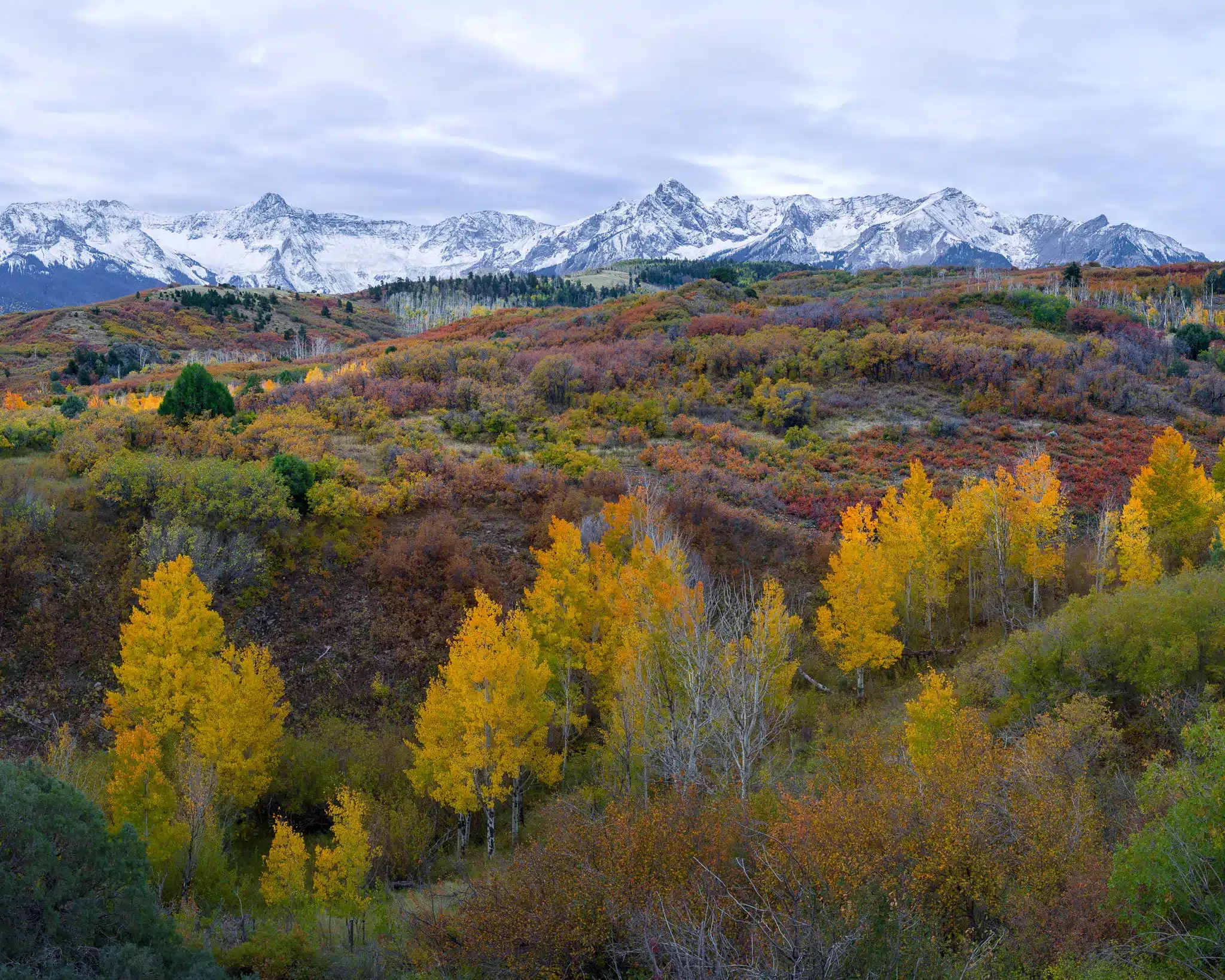
Dallas Divide Sunrise — Mount Sneffels and aspen fall color, San Juan Mountains. View print details →
What to Expect On the Ground
Colorado's San Juan region in late September is not exactly undiscovered. The Ridgway–Ouray corridor on peak weekends is busy. Dallas Divide pulls cars over along the shoulder of Highway 62 by 7 AM on a clear morning. That's fine — most of those people are shooting from the road. Walk 200 yards into any grove and you'll usually have it to yourself.
The 4WD roads (Owl Creek Pass, Last Dollar Road, Imogene Pass) are less trafficked and often better. A high-clearance vehicle opens up a lot of options. Cell service is inconsistent throughout the region, so download your maps and fall foliage reports the night before.
Weather changes fast above 9,000 feet in October. Morning frost is common. A warm afternoon can turn into a 40-degree evening inside an hour if clouds build. Pack layers regardless of the forecast.
Fine Art Aspen Prints
I've photographed aspen groves for more than two decades. The images in my collection from Colorado's fall color season are some of the ones I'm most attached to — they capture a specific quality of light and color that I think translates well to large prints on a wall.
Browse my fall color gallery to see the full collection, or view individual prints including Aspen Color, Curved Aspen, Owl Creek Overlook, and Dallas Divide Sunrise. All are available in multiple sizes and print media, limited edition, with certificate of authenticity.
For more on my approach to photographing in Colorado and the Southwest, read my guide to why I still shoot large format film, or browse the Colorado landscape gallery to see the full range of work from the region.
Frequently Asked Questions
- When do aspen trees turn color in Colorado?
- Peak aspen color in Colorado's San Juan Mountains runs from mid-September at high elevations (10,000–12,000 ft) through mid-October at lower elevations. The sweet spot is late September to early October, when mid-elevation groves are at peak and mountain roads are still reliably accessible. A single location typically peaks for roughly 10 days, so check elevation-specific forecasts before committing to dates.
- Where is the best place to see aspen fall color in Colorado?
- The San Juan Mountains of southwestern Colorado — particularly the Ridgway, Ouray, and Silverton corridor — offer the best concentration of accessible aspen photography. Owl Creek Pass, Dallas Divide, and the Million Dollar Highway all provide excellent access. For sheer scale, Kebler Pass near Crested Butte has some of the largest contiguous aspen groves in North America.
- How do you photograph aspen trees without wind blur?
- Aspen leaves move in the slightest breeze, which creates blur at slower shutter speeds. The best approach is to shoot early morning before mountain thermals develop. For sharp foliage in bright conditions, 1/500 second or faster is usually sufficient. On large format film at f/22 and ISO 50, I watch the nearest leaves and wait for calm before tripping the shutter — sometimes waiting ten minutes for ten seconds of still air.
- What camera settings work best for aspen fall color photography?
- Expose to the right without blowing the highlights on the white trunks. Overcast light often produces more saturated color than direct sun. f/8 to f/16 gives adequate depth of field for most grove compositions. On large format film, Fujichrome Provia 100F and Kodak E100 both render aspen gold with a richness that's difficult to replicate in digital post-processing. If shooting digital, go easy on the saturation slider — the color is already there, and a small adjustment is usually all it takes.
Explore Related Photography
Enjoyed this article?
Subscribe for more photography stories, techniques, and exclusive behind-the-scenes content.
Related Posts
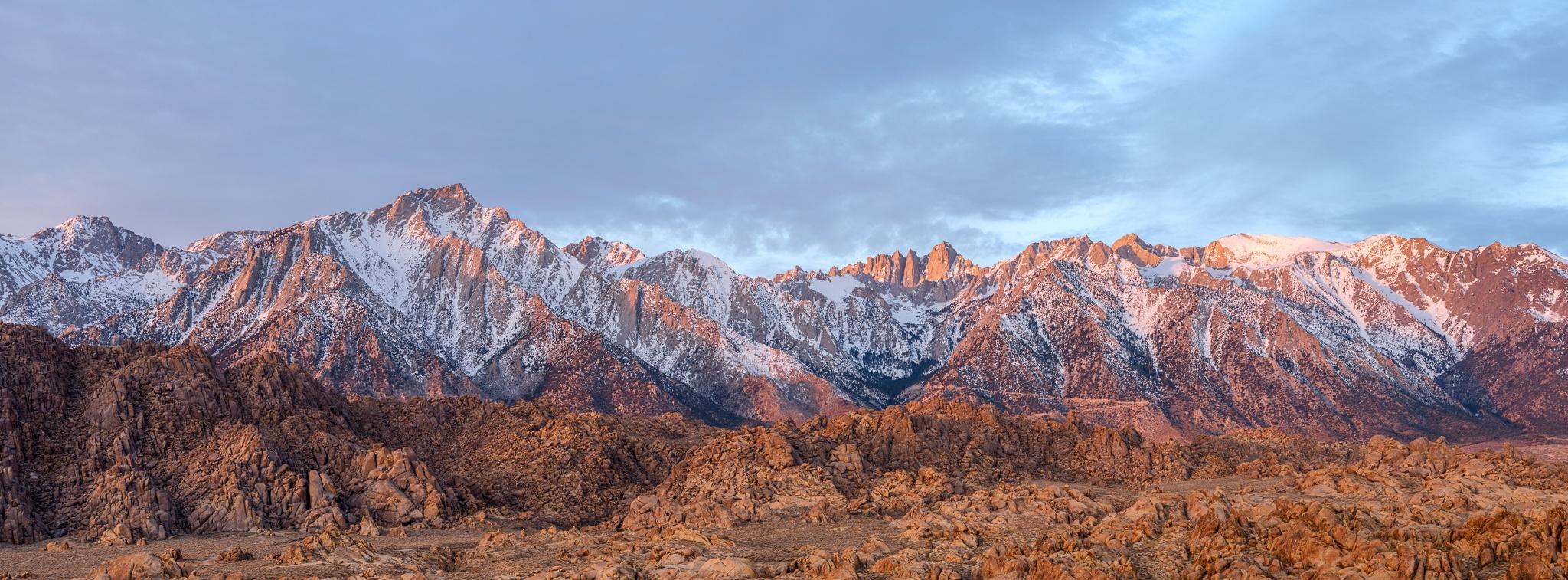
Best Places to Photograph Snow-Covered Mountains in Winter
Winter transforms mountain landscapes in ways no other season can. Where to go, when to go, and what to expect — from Yosemite's granite walls under fresh snow to Zion's red canyon in a storm.
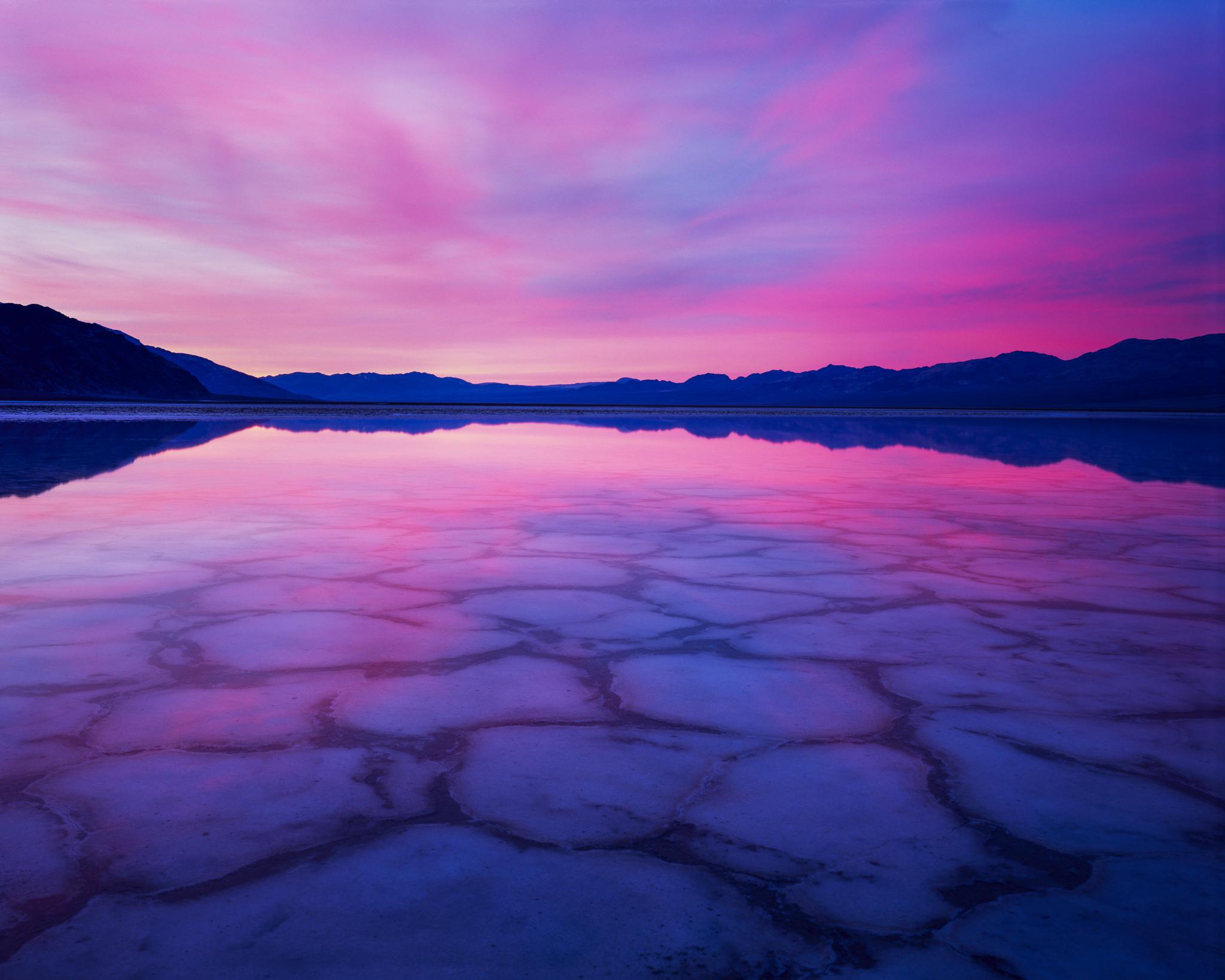
Analog Landscape Photography: Why Film Still Makes Sense in 2026
Most photographers who've tried 4x5 large format film don't go back to digital for their serious landscape work. Here's the honest case for shooting analog in an era when you have no practical reason to.
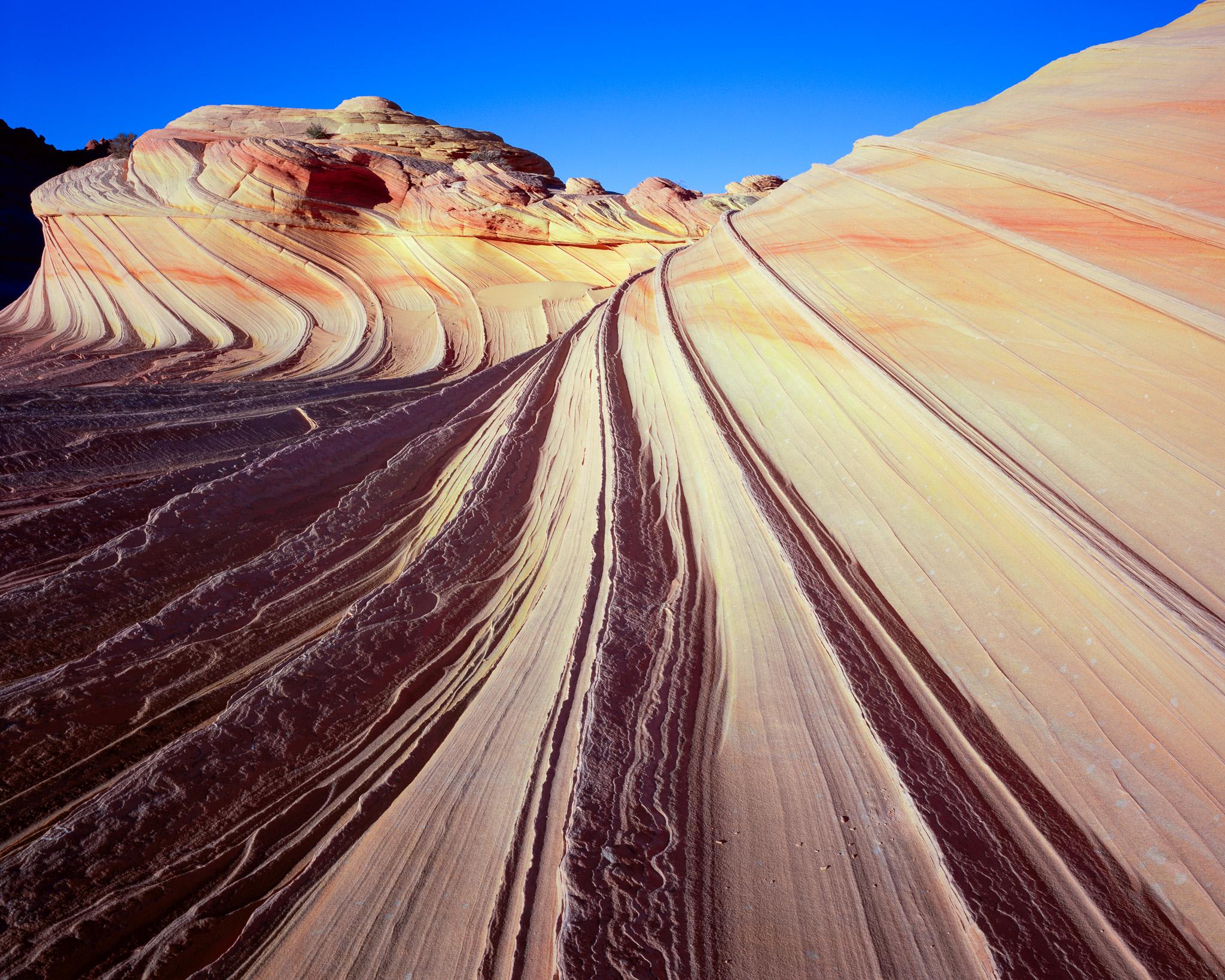
Limited Edition Landscape Prints for Sale: Southwest Fine Art Photography
A look at what makes a limited edition landscape print worth owning — how editions work, what media options hold up over decades, and which prints from the American Southwest collection are still available.
Tags
Marty Quinn
Large format film photographer based in Phoenix, Arizona. Shoots on 4x5 Arca-Swiss view cameras across the American Southwest — Utah, Arizona, Death Valley, and the Colorado mountains. 25+ years behind the lens. Published in Outdoor Photographer magazine (The Last Frame, June 2008). About Marty →